Dos Lunas airport Bed & Breakfast/Hostel

Our address: 21 Calle 10-92 zona 13 Aurora II, Guatemala City.    Reservations: +(502) 2261-4248 or +502 2309-8000

Guatemala City Introduction

Written by Lorena Bleker
Revised by Dr. Mike Reed and Jennifer Hernández

Dear Guest:

Welcome to Guatemala and its capital, Guatemala City; officially named “La Nueva Guatemala de la Asunción” but affectionately known as “Guate” to Guatemalans.  We would like to share with you some background about our city and offer suggestions of places to enjoy during your stay in the capital.

Guatemala City is the largest and most culturally diverse city in Central America.  It sits atop a broad plateau in the Guatemalan Highlands at the favorable altitude of 1,500 meters (5,000 feet) at the crossroads of the ancient trade routes between the cool highlands and the warm lowlands to the north and south. Dense occupation of the plateau extends back to the period between 400 and 600 BC when the Maya city of Kaminaljuyú became the most important trading and ceremonial center of the Central American Highlands.  

Following the Spanish conquest of Guatemala by Pedro de Alvarado, the capital of the colonial Kingdom of Guatemala, was relocated two times prior to settling on its present location.  The first site for the capital, Iximché, founded in 1524 was chosen for its defensive location but proved inconvenient in other ways, like conflicts with the natives, and was not declared capital of the Kingdom by the Spanish crown, like the last three capitals.

In 1527, a site for the capital was chosen in the broad Almolonga Valley at the base of the Volcán de Agua where the town of Ciudad Vieja sits today but in 1541, an earthquake released a torrent of water down the volcano’s slopes, wiping out the capital, which was then, relocated to the center of the nearby Panchoy Valley in 1543.  The beautiful city of “Santiago de los Caballeros de Guatemala”, today called Antigua, remained the colonial capital of Central America until it was leveled by a series of powerful earthquakes in 1773 prompting the Spanish to once again relocate the capital in 1778 to where it remains today. Independence from Spain was achieved in 1821.


Photo by Alejandro Esquité

The transformation of Guatemala into a modern state is a process that is still taking place. Spanish colonial rule was replaced by institutions favoring the powerful landowning class. Guatemala City underwent a renaissance during this period in the late 19th and early 20th centuries and was known as the “silver cup” for its tidiness and elegance.  Immigrants from Europe and North America brought new ideas, practices and styles into the Guatemalan economy and urban society.                          

Photo by Alejandro Esquité

The people of Guatemala City benefited from its position as a center of industry, investment, commerce, education and intellectual exchange.

In the 1960s and ‘70s Guatemala’s fortunes suffered serious setbacks from internal conflicts that deteriorated into a civil war that lasted 36 years and left more than 200,000 deads; and a major earthquake in 1976 that devastated a large area and caused 25,000 deaths.  Guatemala City suffered serious damage to many older and poorly built buildings.  Many lessons were learned from those terrible events, like switching from tile to aluminum roofs for earthquake safety and a commitment to maintaining democratic governments and respect for human rights following the Peace Accords of 1996 that ended the civil war.    

Although positive changes resulted from the time of conflict, we still face problems and challenges like those faced by people in many countries around the world.  The Guatemala City of the 21st century is a modern capital, with the most active economy in Central America.

Photo by Alejandro Esquité

Foreign travelers to any country should make sure they are aware of unsafe situations and places to avoid. Robberies of tourists do sometimes occur in our capital, but we want you to know that Guatemala gives priority to the security and well-being of our foreign visitors along the country’s touristic routes and destinations.   

You will hear negative stories of robbery passed along traveler’s networks evolve in many ways that can undermine visitors’ sense of safety rather than stimulate discussions on ways to travel safely.  Statistics show that foreign visitors are less likely to be sought out for robberies and other crimes.  Common-sense measures for safety should always be followed anywhere in the world, as incidents may happen.

Visitors to Guatemala overwhelmingly speak of the warmth and character of the Guatemalan people – across all cultures and levels of our society.  They find Guatemalans to be among the most hospitable, friendly, kind and helpful people they have encountered in their travels.  This is true in Guatemala City as well as throughout the country.  It is a major reason why so many visitors show so much enthusiasm while sharing stories of their experiences traveling in Guatemala and why so many of them make return trips. 

The capital is a multicultural and multi ethnic city, so the culture is not just in our pre-Hispanic and colonial heritage. The melting pot of races, traditions, walks of life and political view, spice up the daily life of this city.

In this Guide to Guatemala City, we will include a suggested itinerary for unique and interesting place to visit in our capital. You will find a list of museums, restaurants that offer local dishes, archaeological sites within the city, airport information, and important things to know about travelling in Guatemala. 

We are proud of our pre-hispanic and colonial heritage, as well as our modern city. We are happy to have you visit our country and we hope you will include Guatemala City in your future travel plans.

Welcome to Guatemala City!


La Aurora International Airport Arriving

ARRIVING TO GUATEMALA CITY AIRPORT

If you are flying to Guatemala, there are some aspects you should consider making your arrival easier and smoother.

In flight the cabin crew will give you a form that you need to fill, and hand it over at immigration.

 IMMIGRATION:

Once you reach immigration, your passport will be stamped for admission, and the stamp will state the amount of days you can stay, according to your country     of origin, North America, European Union, Australia, New Zealand, for example, will have a 90 days visa to visit the country.

If you need to know how to extend your stay, or pay for overstay, please see our section of Immigration and passports

Once you go through immigration, you will reach the baggage belt if you have checked in luggage, and later to customs, right before the exit lobby. There is one machine right near the last luggage carrousel where you can pay USD2.00 for renting a cart.

Prior to the exit door on arrivals, you will find the tourist information desk, car rentals, taxis and shuttle offices. There are two exit doors, left and right.  Airport parking is right in front.

Make sure you have your pickup service organized and arranged a meeting point, because depending on the arrival time, the arrivals hall can be very busy and overwhelming, so it can be difficult to find your hosts.

SERVICES AVAILABLE ON ARRIVALS

ATM:

There is only one atm before the immigration line, on the left side.  It is a 5B.  All ATMs charge approx. USD5.00 per transaction.  The max amount per day allowed to pull out of the atm is Q2000.00

Mastercard and visa is accepted on these ATMs, but maestro card is not.  If you have maestro card, only the BAC ATM (banc of America Central) will accept that card.  

MONEY EXCHANGE: there are world exchange kiosks on arrival, prior immigration and after immigration, despite of the deals they offer to the passengers, the exchange rate does not make much difference.  Always, before arrival, check the official exchange rate with the banks and the rate of these money exchange kiosks.  www.Globalexchange.com

Pros:  they change all kind of international currencies, they are open at the airport 24/7

Cons:  exchange rate is lower compared to the official rate.

BANKS:  there are no banks on arrivals where you can change USD or Euros. If you see a Banrural agency, that bank is not exchanging currency.  Indeed, none of their banks change money to tourists, unless you have an account with them.

PUBLIC TELEPHONES:  there are no public telephones available on arrivals, neither on departures, only outside on the street, it may be dangerous if you are with luggage there in the middle of the night, plus you need local coins.

INTERNET:  free airport Wi-fi is available on departures, but not on arrivals. Although there is one internet access option without password, they seem to belong to one car rental.

LOCAL INTERNET AND MOBIL PHONE COMPANIES:   There is an improvised kiosk on arrivals where you can buy a local sim card, make sure your telephone is unlocked, specially the iPhone. Tigo has more wide coverage, and if sim card tuenti is available, they have great deals with internet and calls.  The kiosk is not open for the late evening flights.

LUGGAGE CART:  They are available next to the last the luggage carrousel and cost USD2.00. So, if you need one, bring USD1.00 bills in good shape.

TAXIS

Before the exit door on arrivals there is a stand that belong to the airport taxis, you can pay for your service there.  Normally to the hotel areas, they charge USD10.00 for the ride; airport taxis zone 13 are authorized taxis.  You can also call uber if you have internet access.

TOURIST INFORMATION DESK

The INGUAT is the official tourist board of Guatemala, they are not always open but if so, they can give you maps and brochures for different destinations and services and can help you to make a call to your hotel. 

CAMTUR (chamber of Tourism) has a hospitality desk on arrivals hall.  The hosts of these two organizations are not always behind desk ready to give you tourist information or assistance, especially during the evening flights.

MISSING LUGGAGE:  you need to fill a report with the airline, make sure you leave telephone and address where you can be reached and, request a direct phone no. of the baggage department of the airline at la aurora airport.  Most of airlines, specially the US airlines, will deliver your luggage to your hotel.

AIRPORT SHUTTLES: Most of the 4- and 5-star hotels, and hostels and bed and breakfasts located near airport, offer free airport shuttle. Check their schedules as not all of them offer 24-hour service.The airport shuttles of these big hotels are normally waiting for passengers outside the arrival’s hall on the left side.  The tourist shuttle to Antigua and the airport taxis are located on the right side.

WE RECOMMEND

  1. Always check if you leave the airport with your passport and with the address where you go,
  2. Contact the airline if you left something on the plane. The airport has a lost and found office.
  3. Passport must be valid at least 6 months
  4. Many airlines will not let you board with one-way ticket, keep that in mind.

Welcome to Guatemala!


La Aurora International Airport Departure

Departing from Guatemala City Airport

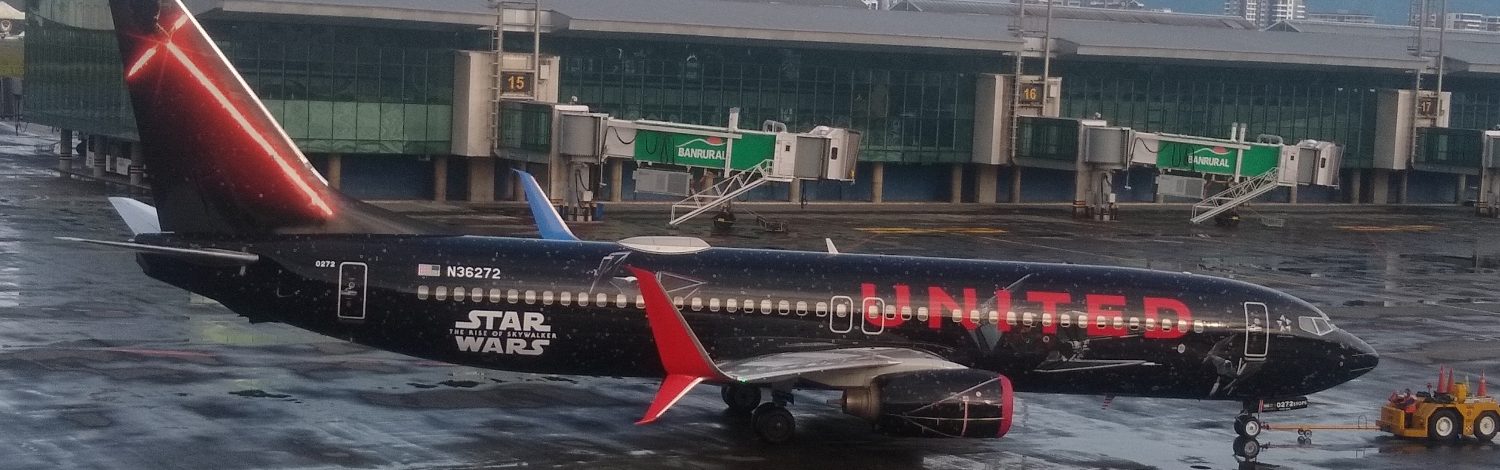
The process for airport check in is very simple, and most airline staff are friendly and helpful.  UNITED AIRLINES have one of the most service minded, and efficient staff and their website is the best for selecting your seats, checking availability and flight information.  If you fly with low cost airlines, check with them before going to the airport if you must pay for printing the boarding pass at the airport.

DEPARTURE TAX:  Your airline ticket already included all taxes. No airline or airport staff is authorized to request any payment from you.

CHECK IN:  Be at the airport, at least 2 hrs. before departures.  Most of counters are closed for check in, one hour before flights.  The immigration and security process may be slow.

Photo by Henk Bleker

AIRLINES OPERATING AT LA AURORA AIRPORT

There are 10 international airlines and one local airline operating at La Aurora Airport: 

INTERNATIONAL AIRLINES:

Local airline

Photo by Alejandro Esquité

When you are checking in and getting your boarding pass…The airline will give you a form that you will also have to give to the immigration officer for your departure control. Make sure you have good sight or bring your glasses or a magnifier, you will need it for this form.  Keep in mind that if you don’t have this form ready when it is your turn for passport control, they will send you back to the line.  Each person must fill the form, some people will tell you that one form per family is enough, but the criteria and information from the immigration officers is inconsistent, so to be safe, fill up one form per person.

Photo by Alejandro Esquité

 RESTAURANTS:
Above the airline counters, there is a food court. Although if you have limited time, go straight through security and immigration.  After immigration, toward the departure gates, you will find all kind of restaurants and cafes where you can enjoy a cup of coffee without being stressed.  Services are open from 4 am. The average price for a decent cup of coffee is Q25.00

Some of the restaurants available near the boarding gates

  • MACDONALS
  • PIZZA HUTT
  • SUBWAY
  • CAFÉ BARISTA
Photo by Alejandro Esquité

If you have a domestic flight to Flores, there is only one café (café gitano) before heading toward the boarding gate.  Not many options really, so be prepared with your own bites.  The two airlines operating Flores serve a simple snack on board, but also the flight is short.  (approx. 1 hr.)

Domestic airlines -destination Flores:

  • Avianca:  www.avianca.com  (operates an ATR, turbo prop. 48 Pax) 2 flights a day.
  • Tag: www.tag.com.gt  (Operates, ATR, Jetstream, Saab) 2 to 3 flights a day. (depending on the season)

AIRPORT LOUNGE:  Zacapa Rum lounge is one of the best at the airport. Located near the boarding gates, some airlines use this lounge for their business class passengers.

https://www.loungeclub.com/en/our-lounges/lounge-detail/GUA2

Photo by Wolfgang, Germany.

DUTY FREE:

Souvenir shops for handicrafts, Zacapa Rum and export quality Guatemalan Coffee are available on the duty-free area, near the boarding gates.   If you buy coffee before going to the airport, pack your coffee in checked in luggage instead of hand luggage.

The award-winning Rum, considered the best rum in the world, is one of the favorite products the tourist like to purchase. Avoid buying the rum in duty free if you have a connecting flight in the US or Europe and if you need to go through security control there.   Alternative you can buy your Zacapa Rum in Villa de los Añejos, in zone 10 Guatemala City   near the Westin Hotel. They have similar prices to duty free and the liter option is available among other fine rums from the Botrán House.

.

Important information

AIRPORT ENTRANCE:

Upon entry to the departure area, Security staff will request you to show your passport.  Failure in showing the passport. They will not let you in if you don’t have your passport.  Airport is not open 24 hrs. you are not allowed to wait or spend the night inside the airport if you have an early flight or a very late arrival.

There is only one place to buy drinks and snacks outside departures: CAFÉ TUCAN. They have Wi-Fi available for customers.

PARKING:  Airport parking cost Q20.00.

To get to the parking from departures level, follow the side road on the left before getting into the airport entrance, and will lead you to the parking near departures. This road begins behind CAFÉ TUCAN.  In that parking there is also the car rental drop off parking. This is the closest parking for departures entrance.

ATM: There is one 5B ATM at the entrance of the airport, hidden behind the money exchange kiosk.

MONEY EXCHANGE:  global exchange kiosk is also available for all kind of currencies.

BANK:  There is only one bank on departures, (Banrural) they will not change any currency. That bank may be useful for you if you need to buy your entrance ticket to Tikal Park or if you need to pay the fine for your overstay.  Banrural is open from 6 am though.

LUGGAGE STORAGE:  This service not available at the airport.

WAITING AREA: There is no place to wait before the time you check in. the airport does not have 24 hrs. service, so you are not allowed spend the night at the airport.

INTERNET:

Free airport Wi-fi, only available in departures and near the Boarding gates.

GOING TO AIRPORT LA AURORA:

Rush hour:  Take your precautions and avoid Guatemala City rush hour. You don’t want to miss your flight.  If you have Wi-Fi get the app Waze for checking traffic.

Rush hour AM:

From 6am to 9 am from Monday to Friday. Direction west to east and south to north,

Rush hour PM:

From 4 pm to 8 pm.  From east to west and from north to south.

If you stay in the city this is the average time you will take to go to the airport from your hotel and vice-versa, (and when it is not rush hour):

  • Zone 1 and 2:  35 to 40 minutes approx.  
  • Zone 4:  20 to 25 min.
  • Zone 9 and 10:  15 to 20 minutes.
  • Zone 13, Aurora I and Aurora II.  From 2 to 5 minutes.
  • Zone 13, Americas:  10 minutes
  • Zone 14.  15 minutes
  • Zone 15 and 16:  25 to 35 minutes.

FROM ANTIGUA:  due to traffic, count a min. of 1 ½ hr. from Antigua, assuming you go straight to airport.

FROM PANAJACHEL: Consider at least 4 hours to get to the city if you don’t stop in Antigua.

PUBLIC TRANSPORTATION TO AIRPORT:  at this moment we are not able to recommend any reliable and safe public transportation to airport.   The Trans metro (green buses) is the best system but unfortunately, they don’t cover the airport route.  We absolutely do not recommend the use of the red buses, they are extremely unsafe and Transurbano bus is not intended for one-time event, you need to buy a bus card. (not practical)

AIRPORT SHUTTLES: Most of the 4- and 5-star hotel from zone 10, and hostels/bed and breakfasts located near airport, offer free airport shuttle. Check their schedules as not all of them offer 24-hour service.

TAXI:  Uber is the cheapest option if you have access to request this service.  Make sure you provide the exact address where you are located, especially if you are in gated areas.

The Yellow taxis run by meter, but it is complicated to get their    services, you need to call them, provide a telephone number, address, etc.  and they offer the service with a min. waiting time of 15 min. The good news is that you can book them in advance and they accept credit cards, USD and local currency as form of payment. Tel. 2332-1515 (Spanish only) Service is reliable.

Photo by Alejandro Esquité

HAVE A SAFE FLIGHT!


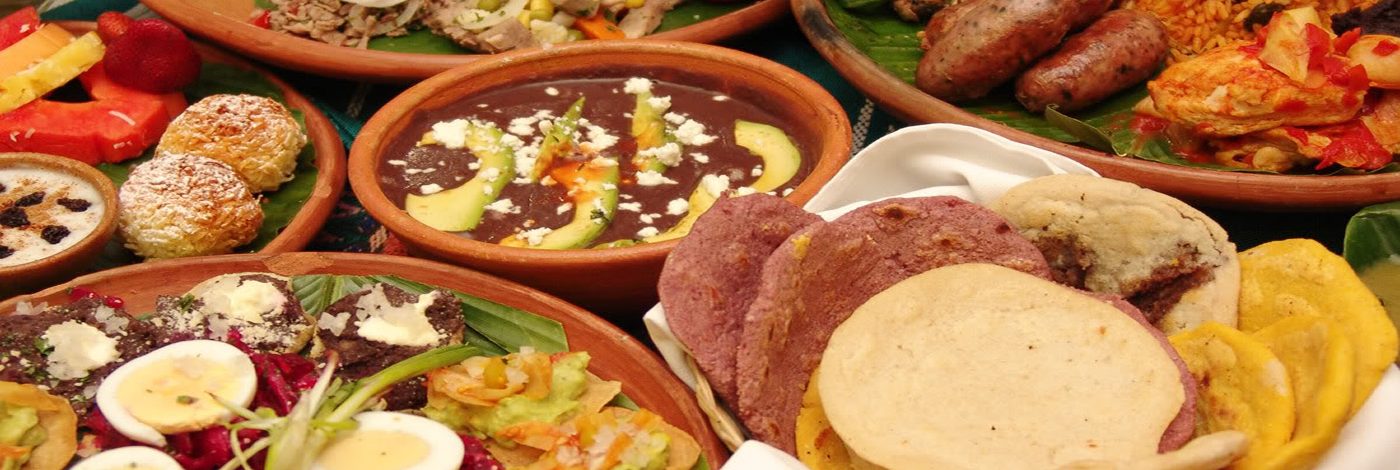
Guatemalan Street Food

In many streets of Guatemala City, you will find hot dogs or mixtas.  The Guatemalan hotdogs are called “shukos”, they are different from the American hotdog.  The shukos are coming with a special type of bread, inside they add guacamole and the coleslaw salad is seasoned with vinegar and spices, the hotdog is grilled in charcoal fire.  The best place to try the shukos and enjoy the whole action of selling the shukos in a kind of drive- thru dynamic is in Hot Dogs El Chino.  They are located in front of Liceo Guatemala school, in zone 5, very close to the beginning of the north side of la Reforma Avenue, zone 10.   (almost across of the botanical garden and the Yurrita Church.)

The mixtas are another option. It has all the ingredients of the hotdogs but instead of bread they use corn tortillas. The original “Mixtas Frankfurt” are the most famous mixtas in Guatemala City.  These are not in a food cart on the streets of Guatemala, they went to the next level and have a small snack bar where you can enjoy them. Open since 1930, Frankfurt is one of the nostalgic places for Guatemalans. https://www.mixtasfrankfurt.com/

Address

11 calle y 7 avenida esquina zona 1
Edificio Lido Local 3
teléfono: 22191818


6ta avenida 6-27 zona 9
Edificio Tivoli Plaza Local 3
teléfono: 23609902

Guatemalan street food can also be found in several neighborhoods and markets

around Guatemala City. The most special place to enjoy these foods beside the local fairs, is inside the central market, located in the heart of the historic district, zone 1.  (One block away behind the Cathedral)

These are just a few options of Guatemalan street food:

Tostadas: hard corn tortilla with guacamole or beans or tomato sauce, garnished with onion, hard cheese and parsley.

Tacos:  Our tacos are the Mexican version of the flautas. These are hard tortillas rolled up and stuffed with meat or potato.  The top is garnished with guacamole, tomato sauce, (not ketchup), hard cheese, onion and parsley.

Rellenitos:  plantain patties stuffed with sweet beans, sugar and cinnamon, they are fried together, and it is a very nice dessert.

Elotes locos:  crazy corn, on the cob with special cover of ketchup, mayo, mustard, hot sauce and hard cheese. If you don’t want the corn with all the circus, just order “elote cocido” that means “only cooked corn”, you will get them with a bit of salt and lemon, if you like to add some.

Another way to eat the corn are the “Elotes asados” or grilled corn.! Add some lemon and salt and ready to eat!

Atol de Elote:  This is a hot corn drink that it is thick, smooth and sweetened and spiced up with vanilla cinnamon, sugar, etc., it is absolutely delicious.!

Chocobananos;

This is like a dessert, made of banana, chocolate and that´s it!  It is frozen, in most of the local neighborhood stores they sell these “chocobananos” for a cheap price.

Helados de frutas: These are local made ice cream made of natural fruit

water and sugar, some of them with milk instead of water.


All the above street food photos are shared from Aldea Tierra colorada facebook page. https://www.facebook.com/pg/TCG1997/photos/

Fresh tropical fruit “Bolsa de frutas”:

We have the best fruits, and you can enjoy them also, ready to eat. These “bolsas de frutas” (fruit bags) can be found in all the local markets and some street vendors around Guatemala City. The fruit bags can be spiced up with salt, lemon, chili powder and pepita powder, this mix taste better with the mangoes and pineapple. 

Photo by Henk Bleker

Goat milk: Leche de cabra:

Quite often you can find a guy with a bunch of goats walking around in the middle of the busy historic center. Their business is, selling fresh goat milk in a plastic cup. Oh yes! from the goat to your cup, for approx. Q5.00  

Photo from: http://cattusguatemalensis.blogspot.com/2011/03/oficios-y-negocios-en-guatemala.html


A Day in Guatemala City

By Claudia Wood, Canada.
Photos:  Claudia Wood.

Day in Guatemala city

Guatemala City – this is NOT to be missed. People talk about how unsafe Guatemala City is but really enjoyed it and never felt unsafe. But there are so many beautiful and interesting things to see. If you worry about visiting there, hire a guide. Believe me, it will be worth it! We hired Fabio Saenz with Authentic Guatemala. He was reasonable, very knowledgeable and an excellent driver. His English is excellent, and he will customize your tour to see the places you want to see as well as a few of his own. You can contact him by email or phone and will find him reliable in getting back to you with suggestions. His email is Fabio@authenticguatemala.com and his phone number is +502 4715-9095. His webpage: www.authenticguatemala.com.

Here is a summary of what we saw while visiting, along with my personal take on the experience. Just to put things in perspective, we toured on the day of the big march in January 2019. It was interesting to experience the historical area under extreme police presence – it was probably the safest place in Guatemala that day!

Day One

On our arrival day we had enough time to visit a few places on our own. We had the hotel’s driver drop us off and pick us up, because yes, we were a bit nervous to be on our own. We needn’t have been – we felt totally safe in the places we visited.

Our first stop was the National Museum of Anthropology. The museum was worth the trip. It has an amazing collection of artefacts and stelae from back as far as 800BC. There is a huge scale model of Tikal which is good thing to see before you visit there. The carved stelae are huge and in amazing condition. Everything is housed in a very cool-looking building. The displays are very nicely done and there is lots of English!

On the same site there are two other places to visit, the National Gallery of Modern Art and the Natural History Museum. We skipped the latter as it was all in Spanish and ours is very limited. The National Gallery of Modern Art has a beautiful collection of art, some very stunning work. Definitely worth an hour of your time if you like art!

We had agreed to meet our driver at the Artisans Market just down the block from the museums, so we wandered down the road, about a block walk. I expected a market like those we have seen in the past, cluttered and noisy and not very clean, but it was more like a bunch of tiny stores and there was almost no one there. Each seller had their own small booth, although many of the items repeated themselves over and over and many, I suspect were massed produced in China. Loved all the bright colours. Unless you are shopping for something, you can see this in a half hour or so.

Across the street from here is the Zoo. Unfortunately, we just didn’t have enough time but on a full day, this could easily be added in. We found this whole area very safe-feeling and wouldn’t hesitate to visit all of these spots on our own.

Day in Guatemala city

Day Two

Started our day with a traditional breakfast of eggs, beans, fried plantains and coffee (most important as after not having any on our flight I was feeling caffeine deprived!). Our guide, Fabio arrived right on time and we headed out to tour Guatemala City. This is something not undertaken by many tourists. Whether it is a fear based on past history of it being an unsafe place or a lack of interest, it just isn’t a hot spot on the tourist trail. Wow – so many people are so wrong! We could have spent two or three days here.

Guatemala City is huge with over four million people. It grew outwards like a snail from its original centre and sprawls for miles and miles. It is divided into “zones” and is relatively flat in the centre but surrounded by hills. Traffic isn’t nearly as bad as some large cities and cars are relatively new, mostly Japanese and Korean with few US built cars as parts are expensive. There are lots of buses of varying quality…red chicken buses, blue commuter buses and green ones that travel only in certain areas but are much more modern. The city is relatively clean and has a lot of green spaces, parks and playgrounds. It is a mix of old colonial structures and in the touristy zone, modern hotels and not so high high-rises. Nothing over ten stories due to the earthquake risks.

Our first stop was at the National Theatre, which in its heyday must have been beautiful. We just saw the outside, but it opens regularly to host theatre, opera, symphony, ballet and other performances on a regular basis. Hard to tell what the inside is like, but the outside looked a little neglected and the building itself was impressive. It was designed by architect Efraín Recinos whose name we saw several places in the country.

On the same grounds we visited the Military Museum and the original San Jose Fort. Inside the fort was a historical presentation of Guatemala through its many years of war. Outside on the roof, between the canons, the view was impressive in all directions. We got an idea of how big this city is! Off in the distance below, we could hear sounds of the protestors outside a government building.

Our day was somewhat modified from its original plan due to some road closures and building closures. We weren’t sure what to expect. Our guide drove with a traffic app open on his phone, searching out the best routes to avoid traffic so he could get us to the sites we wanted to see.

A short drive from the Cultural Centre was the Guatemala Relief Map. This spot was quite amazing. It took 16 years for an engineering team to travel the country to amass the geological information and then another year to build it. And all of this was done in 1905! It is about 60 meters across in each direction (my guesstimate), built to a scale of 1:10000 with elevations built 1:2000…so it is BIG! It was an interesting to plot out our route.

After the relief map, we headed to the downtown historical area.

Guatemala, like many Central American countries has been a country in constant civil unrest for what seems forever. They have been relatively “at peace” since 1996 when the civil war ended. But poverty and inequalities are still very much a part of life here, corruption is rampant, and the natives seem to be growing hostile. In oversimplified terms, the UN sent in a commission to investigate corruption at high levels of government. Recently, the government ordered them to leave the country. The locals are protesting this, saying the government hasn’t the right to do so. The government is saying the commission overstepped its boundaries and became involved in areas they weren’t supposed to be touching and so has ordered them out. This week, there are protests and blockades around the country with a large protest march in Guatemala City today.

We parked nearby the historical centre and walked to the central plaza. Because this area is home to many government buildings, security was unbelievable. It would have been a good day to rob a bank somewhere else in the city because it seemed every available police officer was guarding an entrance to a building or blocking a street. There were thousands of them, including traffic police, regular police and riot squads!

Around the Presidential Palace, which is now a cultural centre, the police stood shoulder to shoulder, guarding every entrance. This building covers a very large square block so a LOT of police! The building sits on one side of the large Central Parque, where there was a very small group of noisy but peaceful protestors, but mostly just families and sellers.

Day in Guatemala city

Our guide, Fabio, took us inside a couple of buildings that used to be private residences but have since become government offices. One was the office of the electoral commission, which is gearing up as an election will be announced this week. Tomorrow is the installation of a new president who was elected last July and the official announcement of the new election that will take place in July. Today the outgoing president gave his year end report and exit speech – likely another reason for the timing of the protests. At any rate, the house was beautiful, inside and out… neocolonial architecture with terrazzo floors, murals on the walls and ceilings, a lovely central courtyard. What were once bedrooms and bathrooms around the courtyard are now offices. The dining room is now the media room.

Our next stop was to be the Central Market but as we neared it, we could hear the voices of the protestor march. We watched for a bit, impressed by the number of people marching, then headed down into the market. Fabio stopped us at a food stand, one of the oldest and most popular around, run by the same family for over 60 years. We sampled a few things…chili rellenos, tostadas and then the woman gave us each a small pastry stuffed with the most delicious sweet filling. It was enough of a light lunch to get us through the afternoon. The market was remarkably clean, even throughout the wet market areas. Lots of souvenirs but for us, not yet!

From the market we wandered down Piñata Street – every store had huge piñatas hanging outside. Who knew there could be so much demand for them! Roads around the national building where the president was giving his speech were blocked off so we took a roundabout route to a few more stops, including the old post office, which is now an arts school and a street archway that is a copy of a famous one in Antigua that we will see later in our trip.

Day in Guatemala city

We visited a few big churches, including Iglesia San Francisco, which was stunning, a couple others whose names I have already forgotten!

We took a green bus back to the Central Parque area and while my husband and I visited the Metropolitan Cathedral, Fabio went to retrieve the car. The cathedral was beautiful. People were lined up to see the black Jesus, which is a big thing in Guatemala. Many of the items in the church were brought from Antigua when the capital was moved. The pews went on forever. They would need a good sound system to hear the priest. Lots of locals inside.

It had been a long day and a lot of walking, so it was nice to sit in the car! And we weren’t done yet! We drove to see Iglesia La Merced, but it was closed today due to renovations. We did get to Cerrito del Carmen (church on the little hill). It was built originally in 1620 and then rebuilt after one of the big earthquakes. I have read that it used to be a spot for drug deals and criminal activity, but it is now a park area where locals gather to run, exercise and play games. The church is small, but the view is BIG!

Our final stop was a treat! Fabio took us for a traditional Guatemalan hot dog! There is neighborhood that specializes in these with several shops all along the same street. As you drive by, they try to wave you in. He took us to his favorite, in a small cafe where you could watch the owner as he prepared your hotdog…grilled bun, lettuce, mustard, guacamole, onions and chopped smoked sausage…tasty indeed!

We drove home through the more modern areas, down a beautiful treed and grassy boulevard, Avenida la Reforma. It was designed after the Champs Élysées. Then we travelled the Avenue of the Americas which had plazas every few blocks representing all the Latin America countries.

Day in Guatemala city

centralamerica2019.wordpress.com


Guatemala City Restaurants

Food Service

(Guatemalan food)

Where is the best place to eat Guatemalan food?  There are a few very nice restaurants in Guatemala City where you can enjoy delicious meals from the national kitchen:  Guatemalan food is a fusion of Maya, Hispanic, Sephardi, and Caribbean cultures, with German and Mexican influences. Guatemalan´s favorite food in general is the grilled steak, which is why you will find a large amount of steak houses all over the city.  Another favorite is ceviche; Guatemalans love ceviche but we recommend you not to eat this food on the street, as it is seafood.

A favorite snack is “chicharrones”.  (pork skin) with corn tortilla and “chojin”, that is a chopped radish salad served as topping to the chicharrones. Tortillas with chicharrones are accompanied by fried onions and fried jalapeño chillies, guacamole, etc.

GUATEMALAN RESTAURANTES IN HISTORIC DOWNTOWN

ZONE 1

PAN AMERICAN HOTEL

Pan American Hotel is located in the heart of the historic downtown, near the Plaza Mayor, between 5th and 6th. avenue and 9th. Street of zone 1.

The building was, until 1942, the Hotel Astoria and this beautiful hotel is one of the many witnesses of the changes that have occurred in Guatemala City. The elegance of the Pan American Hotel is reflected in the structure of the hotel with the geometric beauty of art deco. Inside is decorated with indigenous motifs, textiles and handicrafts, furniture that evoke the colonial era and photos of the place across more than a century of existence, witnessing the cultural evolution of Guatemala. The setting is harmonized with piano and marimba music in special events, and the entire hotel is decorated with candles and flowers. Its midday buffet makes available the flavors of Guatemalan cuisine.

Photo: Pan-American Hotel

The purpose of this place is to provide the visitor with a historic atmosphere and a nostalgic sense of the old times, when the city was called the “Silver cup”. Its staff wear beautiful regional costumes and at the entrance of the restaurant, you will find a young woman who prepares corn tortillas in a traditional way. There is a variety of Guatemalan native dishes that its menu offers, from appetizers, main courses, desserts to natural soft drinks and the great coffee that has made the country famous throughout the world.

CENTRAL MARKET

In the heart of the Historic Center of Guatemala City is the Central Market, which since the end of the 19th century is “The place” where traditional Guatemalan cuisine is prepared at very affordable prices, dishes like chopped radish with pork rind served in hot corn tortillas; rolled pork head and vinaigrette legs accompanied by corn tortillas, special dressings, desserts and drinks. Some dishes are only prepared on special occasions, but others are available all the time.

The theme of these places is that they offer food on foot since they follow the concept of fast food for consumption and not a restaurant experience. However, you can sit in the “comedores” at the market and enjoy a nice hot chicken soup, while some musical groups perform near the diners.

Some of the Guatemalan food that you can order in the Central Market are: 

  1. Pepian (chicken mole)
  2. Caldo de Gallina (Chicken soup)
  3. Patitas a la vinaigrette (Pickled pork muscles and lower legs)
  4. Tortillas con chicharron y chojin (Radish with pork rind in a corn tortilla)
  5. Revolcado (rolled pork head)
  6. Tostadas de guacamol (fried tortilla with guacamole)
  7. Tacos de papa (rolled up tacos stuffed with potato)
  8. Dobladas (fried tortillas stuffed with meat)
  9. Caldo de res (Vegetable meat boullon with vegetables)
Photo by Claudia Wood, Canada.

BAR EL PORTAL:

Known as “El portalito”, this is a nostalgic bar located in Pasaje Rubio, inside Portal del Comercio around the Plaza mayor.  This bar is famous for its “chibolas” (tap beer in a large round glass) and for its “mojitos”.

Back in the 50´s Che Guevara used to come to this place for a drink; many intellectuals have also used the “portalito” as headquarters.

This old-fashioned bar with an excellent service will transport you to the past, not just for its old-fashioned decor but for its overall atmosphere.  Live music is available usually at midday.


Photo by: Fresita la Hada, (nomada.gt)

ARRIN CUAN

Arrin Cuan, is recognized by Guatemalans and tourists that enjoy different dishes from the Guatemalan kitchen. One of the goals of this restaurant is to highlight the Guatemalan gastronomic heritage and share with national and foreign tourists, the great multicultural value that Guatemala has.

Since 1995, Arrin Cuan won three awards at the International Gastronomic Festival that is celebrated annually in Guatemala. Currently, Arrin Cuan offers 40 different typical dishes to their visitors.

Photo: Guatemala.com

ARRIN CUAN

Arrin Cuan. is familiar to Guatemalans and tourists that want to enjoy different dishes from the Guatemalan kitchen. The main goal of the restaurant is to highlight Guatemalan gastronomic heritage and share with national and foreign tourists the great multicultural value that Guatemala has.

Since 1995, Arrin Cuan has won three awards in the International Gastronomic Festival that is celebrated annually in Guatemala. Currently, Arrin Cuan offers 40 different typical dishes to their visitors

Photo: Guatemala.com

OTHER GUATEMALAN RESTAURANTS IN HISTORIC DOWNTOWN:

ADOBE

7a. Avenida 9-45 Zona 1

http://www.facebook.com/restauranteeladobe

LA COCINA DE LA SEÑORA PU
6ª. Ave A.  10-16 zona 1
Sunday closed,
http://www. Senorapu.com

GUATEMALAN RESTAURANTS IN ZONA VIVA

ZONE 10

KACAO
2ª ave. 13-44 zona 10.
Website: http://www.kacao.gt

CASA CHAPINA
1a. Avenida 13-42 zona 10
http://www.restaurantecasachapina.com

STEAK HOUSE HACIENDA REAL
5a. avenida 14-67, zona 10
Tel. 23808383
http://www.haciendareal.net/gt/

Useful tip: This steak house has a free shuttle, hotel-restaurant-hotel, if you make your reservation and request this service.


Guatemalan coffee

One of the finest coffees in the world
Written by: Lorena Bleker
Edited and revised by Ailsa Naismith. Bristol, UK

Photo: Philadelphia Farm, Antigua Guatemala

Coffee is a personal taste, yet, there are ways to appreciate a good coffee.

Guatemalan coffee is rated by many experts as one of the best coffees in the world.  The coffee varies from region to region and harvested from different altitudes and that is why the flavors of Guatemalan coffee are so special and complex.

The flavor of Guatemalan coffee is medium to full-bodied, it is perfectly balanced in its acidity and in most harvests, you can appreciate the individual tones; we could say in general that; a cup of Guatemalan coffee will carry the chocolate, smoky and spicy tones. 

Some of the Guatemalan´s finest coffee is produced in the farms around Antigua Guatemala and the slopes of the volcanoes nearby.  If you go to Antigua Guatemala you can visit a few farms like Philadelphia Coffee or la Azotea Farm, which also holds a Coffee Museum. Coffee from Cobán is a high-quality acidic coffee, due to its altitude. The most famous representative of Cobán coffee is Kaffee Dieseldorf. The Huehuetenango coffee is noted for its finest acidity and unique flavors and the best coffee of this area, according to experts, is the one coming from El Injerto Farm.

Guatemala still holds old species of trees such as bourbon, thanks to sponsored programs that are enabling coffee producers to continue cultivating high quality trees for the gourmet market.

How did the coffee boom start in Guatemala?

The Germans in the 19th century introduced coffee to Guatemala. Their immigration to Guatemala began with the socio-economic crisis in Germany, during the transition to the industrial era. The first Germans arrived at the Belgian colony which was settled in Santo Tomas, Puerto Barrios, Guatemala in the 1840s,

Guatemalan Coffee

After their first arrival in Guatemala, the Germans also settled in the capital and in many other parts of the country and devoted themselves to their profession in crafts, business and commerce. This immigration increased significantly in the last decades of the 19th century due to the industrial and commercial expansion of the German Empire as well as the opportunities in Guatemala under the liberal regimes which favored concession of land to foreigners especially those from Europe and North America. The Germans introduced the cultivation of coffee and developed a big industry with trade and export. At the end of the century they controlled one third of the coffee production in Guatemala and exported two thirds of its production to Germany.

By the end of the 19th century about one thousand Germans lived in Guatemala, and by 1920s, the number grew to up to 3,000. The Germans founded associations, clubs, schools, a Protestant church and a German newspaper. Through these institutions they preserved the characteristics of their nationality, language and culture.

By 1940 the German community was a visible and influential force in Guatemalan society and its economy. During the World War II, under the strong economic and political pressure from the United States, the Guatemalan government confiscated all the assets and properties from them.  Many Germans were deported back to Germany, just a few were left behind in Guatemala and kept their farms.  It has been said that the ones left; claimed to be Jewish Germans, therefore they could stay.   The Dieseldorff is one of the German families, allowed to stay, and their farms near Coban are still producing good quality coffee.

According to the German embassy, nowadays there are approx. 5000 Germans registered and living in Guatemala and an unknown number of descendants from the earlier immigration.  Guatemala currently has a strong community of Germans who make up the majority of European immigrants in the country, and it is also the most populous German communities in all Central American countries.

Where to buy good coffee in Guatemala City?

 There are a few places in zone 13 where you can buy good coffee to take home.

The coffee you enjoy at Dos Lunas, comes from Antigua Guatemala. We also sell coffee in portions of 200 grams. In beans or ground.

Photo: Finca el Injerto

The Guatemalan coffee, ranked best worldwide, comes from the Finca el Injerto in Huehuetenango.   You can enjoy a cup of their best harvest for Q30.00 (approx. USD4.00 cup) A pound of this coffee cost Q140.00 or approx. USD18.50

For more information visit their website:  https://fincaelinjerto.com/

And their list of products:  https://fincaelinjerto.com/collections/all

If you want more information about Dieseldorff Kaffee, find them at: https://www.facebook.com/DieseldorffKaffee

Guatemalan Coffee

Between Dos Lunas and the airport there is one Coffee Roasting company called Godoy’s coffee.  They also have a coffee tour and you can taste their coffee while there.  For more information visit their website: www.godoyscoffee.com

A few more places are good options for a nice cup of coffee:

If you visit the Historic Center, these are a few places where you can enjoy a good cup of coffee:

  1. Café León”.   8a. ave. 9-15, zona 1.  http://www.cafeleon.com/catalogo.html
  2. Café del Centro.  8ª- Avenida 9-12 zona, 1
  3. La Tacita de Plata.  11 calle 6-11 zona 1.  @latacitadeplataguatemala
  4. Café de Imeri.  6ª calle 3-34, zona 1.  @deimeri.caferestaurante
Photo: Guatemala.com

If you are interested in where some of the best coffee in the world comes from, this book is for you.  “The history of coffee in Guatemala”, by Regina Wagner.

 English version is available in Amazon.com


The Guatemalan Breakfast

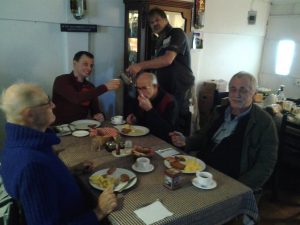
The most important meal of the day for Guatemalans is the “desayuno tipico” or typical breakfast, it is a heavy meal but super delicious. Now, there are different versions of the Guatemalan breakfast, but the base is eggs, beans and plantains but….

…The original and typical Guatemalan breakfast comes with:

Porridge (we call it “mosh”)
Eggs (can be fried, scrambled, with tomato and onion, rancheros, divorced… and the imagination is the limit)
Refried beans
Fried plantains
Breakfast sausage, chorizo or longaniza (longaniza is a type of spicy chorizo)
Fresh cheese
Sour cream
Homemade hot sauce
Fresh fruit
Tortillas or bread
Sweet bread (for the coffee)
Orange juice
Coffee or coffee with milk

Some combinations for the eggs are

  • Huevos con cebolla o tomate:  These are scrambled eggs, cooked with “Pico de Gallo” that is tomato, onion and bell pepper.
  • Huevos rancheros:  This is believed to be from a Sephardi heritage, the traditional way of making these eggs is like the “shakshuka” eggs made in Israel.  Guatemalan original “huevos rancheros” are made in the same way.  In a skillet with a tomato, garlic and onion sauce and poached eggs.
  • Huevos divorciados: The divorced eggs is from Mexican influence; two friend eggs are topped half in red and half in green tomato sauce.

If you like to have your eggs in a specific way, these are the words in Spanish you need:

  1. Sunny side up:  Huevos estrellados
  2. Scrambled:  huevos revueltos

Another breakfast that is popular in Guatemala is the Tamale breakfast

This breakfast is normally served for a special occasion, like Christmas and to celebrate after some of the catholic rituals happening in the morning like baptism and first communion. Although, this breakfast is popular in any occasion, like no special occasion at all.!

The tamale is made of corn dough stuffed with special mole that is a mix of red tomato and bell pepper sauce, spices, local nuts, sesame, and meat (pork or chicken)

The fancy tamales are decorated with capers, olives and dry plumbs.  The tamale is wrapped in banana leaf.

Normally served with hot chocolate, coffee or Atol (sort of thick and hot drink), others serve arroz en leche, (Rice pudding that is a bit watery) and hot fruit punch for the Christmas tamale.

A nicer version of the traditional Guatemalan tamale is the famous “Pache” it is also a tamale but made with potato instead of corn dough


La Aurora Zona 13

Guatemala City Travel Guide

SUGGESTED TOUR 1:    LA AURORA
SUGGESTED TOUR 2:  HISTORIC CENTER
SUGGESTED TOUR 3:  ZONA VIVA

LA AURORA
ZONE 13

The tourist complex La Aurora is located approx. 1km away from the International Airport La aurora in zone 13.  It is a safe area and all the places to visit are within walking distance.

The area is hosting nice places to visit such as:

  1. Artisans Market
  2. La Aurora Zoo
  3. Children Museum
  4. Archaeological Museum
  5. Modern art Museum


ARTISANS MARKET
Business hours:  Monday-Sunday
From 9:00 until 18:00 hrs
Entrance: free of charge.
Shops accept Visa, Master Card, USD and GTQ

Facilities available:

Services_ATM_Coffee_Bathroom_Bus_Service

LA AURORA ZOO
Business hours:  from Tuesday-Sunday
From 09:00 hrs. until 16:00 hrs.
Entrance fee: Children: Q.16.00 /Adults: Q33.00
*Visa and master card accepted

La Aurora Zoo
www.laaurorazoo.org.gt

Facilities available:

Services_ATM_Coffee_Bathroom_Food_Bus_Taxi_Service
ARCHEAOLOGICAL_MUSEUM

ARCHEAOLOGICAL MUSEUM
Business hours:  from Tuesday-Sunday
From 09:00 hrs. until 17:00 hrs.
Entrance fee:  (Cash only)
Locals: Q5.00   / Foreigners:  Q60.00

ARCHEAOLOGICAL_MUSEUM
Museo Nacional de Arqueología y Etnología

Facilities available:

Services_Information_RestRoom_Bus
MUSEUM

Museum of Modern Art
Business hours:  from Tuesday-Sunday
From 09:00 hrs. until 17:00 hrs.
Entrance fee:   (cash only)  Local:    Q5.00 /Foreigners:  Q50.00

Museum of modern art
Museo Nacional de Arte Moderno “Carlos Mérida”

Facilities available:

Services_Information_RestRoom_Bus

Other services available in the area:

La Aurora airport

LA AURORA INTERNATIONAL AIRPORT
DEPARTURES-ARRIVALS-CAR RENTALS

Cafe - Coffee Shop

Café Crepette at the Alliance Francaise
McDonals Boulevard Liberacion
Burger King, Boulevard Liberacion
Panda express, Dennys and Papa Jones.  Paseo Liberacion
Food court at La Aurora Airport
Tucan Café airport outside departures
 La Aurora Club. Pool service.  Café from 12 hrs to 16 hrs
Restaurant from 6 am to 4 pm.
Website: www.clublaaurora.com

ATM Machine

ATM Machine Locations
La Aurora International Airport
Banco industrial, Combex.
Artisans Market
Shell Gas station in front of the Acueduct
Supermarket Paiz Americas and Paiz Paseo LIberacion.

Wifi

WI-FI
La Aurora airport inside departures
Café Tucán la Aurora airport departures entrance
Café Barreto La aurora airport arrivals lobby
McDonals Blvd. Liberacion
Inside transmetro buses

Taxi Service

TAXIS
Taxis Aeropuerto zone 13
La Aurora International airport
Taxi zone 13 Outside Crown Plaza Hotel Americas Avenue

Hospitals


HOSPITALS
Hospital Virgen de Loretto (Air force) Tel. 2261-4004
https://es-la.facebook.com/HospitalFAG/
Hospital Maranatha   Tel. 22855200
https://www.hospitalmaranatha.com/

supermarkets

SUPERMARKETS
Paiz Américas
Paiz Paseo Liberacion

TransMetro

SAFE PUBIC TRANSPORTATION  (it is a bus, not a metro)
Transmetro  (Acueducto Station)
Transmetro (Fuerza aérea station)
Website: https://rutastransmetro.muniguate.com/


Learning Spanish in Guatemala

Learning Spanish in Guatemala

Written by Lorena Bleker
Revised by Jake Mahon
Edited by Tom Lingenfelter

Considering learning another language as a new year’s resolution?  Guatemala is the no. 1 destination in Central America for students eager to go overseas to learn Spanish, the second most important language in the world.  Choosing our country to learn the language will give you the opportunity to acquire Spanish with a neutral accent, live with local families, and save a lot of money because the Spanish schools here are offering great deals for students.

Spanish is not just a fun language to learn, it is also very useful. If Spanish is involved in your career or if you travel  Latin America or Spain, you can at least have a clue what the boys or girls are gossiping about you!  After all, during your cultural travel experience, you also need to learn how you get your cold beer or ask directions to the toilet, instead of the dark room!  Yeah, that one!

Now, once in Guatemala you can choose different destinations for your language classes.  These are the top 3 most popular options:

  • Antigua
  • Quetzaltenango
  • Lake Atitlan
ANTIGUA GUATEMALA:Photo courtesy of TGW.  https://radiotgw.gob.gt

A beautiful Spanish colonial town with an 16th-century setting. It is a UNESCO Site conveniently located one hour away from Guatemala City.

Pros:   Offering great housing options, charming school settings, opportunities to volunteer and choose extracurricular activities. Antigua is classy and romantic with many services for tourists.  It has great hotels, restaurants, tourist sites, etc., as well as a clean accent that it is optimal for learning the language. The weather is perfect most of the time.  This place is really a cultural destination.

Cons:  The cost of living is more expensive, it can be crowded on weekends, and, as a popular tourist destination, where a large percentage of the local population speaks some English, it’s not always easy to practice Spanish.

Where to start looking?  

For more information about schools in Antigua, visit:

www.asolingua.com

QUETZALTENANGO (XELA):  Photo courtesy of Inguat.  http://vivexela.visitguatemala.com

The second largest city of Guatemala, a mix of Maya quiche and ladino culture.  Don’t take it for granted, because Xela (its popular name) has an interesting flavor, unique personality and a great history.

Pros: Xela has a large variety of options and prices.  There are affordable plans of room and board, mainly living with host families or guesthouses. If you’re interested, there are more opportunities to volunteer here. People have a good accent in general.  The local food is good.  Xela has a more Guatemalan atmosphere with an international twist.  It is also cheaper than Antigua.

Cons:  Xela has many options that may make it difficult to choose and getting there may take up to 5 hrs. of travelling by bus. It can get cold at night because of the altitude (~7,600 feet / 2,300 meters above sea level)!

Where to start looking?

For more information about Spanish schools in Xela, visit: www.xelapages.com

LAKE ATITLAN:

Photo courtesy of Julian Ursano, Canada

Lake Atitlan is one of the top destinations to visit in Guatemala. Famous for being surrounded by 3 volcanoes, you can also visit the different towns around the lake, each with different atmosphere that worthy of exploration.

The most popular locations for study Spanish by the lake are:

  • Panajachel
  • San Pedro La Laguna

Pros: Without a doubt, Atitlan is one the most beautiful lakes in the world.  As the home of many expats of all ages, it has a very international atmosphere. There are good prices for schools and accommodation, as well as great dinner and party options in a bohemian atmosphere. It’s also fun to explore each town around the lake, as each has its own identity.  You should come to the lake if you need a break. Total relaxation! This is a destination for all generations. Life is cheaper in San Pedro than in Panajachel.

Cons:  The accent may not be as neutral as Antigua, since for some teachers Spanish is their second language, but it is good enough to make yourself understood. For beginners is a good place to learn as Spanish because the language is spoken slower than in Antigua or Xela. Weather is great, but It can also get a little chilly at night.

It may take a while to get to San Pedro, it is a bit secluded, but there are more transportation options to/from Panajachel and from there you can take a boat to San Pedro.

Where to start looking?

  1. Jabel Tinamit Spanish school (www.jabeltinamit.com)
  2. San Pedro Spanish school (https://www.studyspanishinguatemala.com)

For more information about schools around the lake visit:

www.asolingua.com

Ok. We hope this information help you to choose your next travel destination and give you a start for your educational journey.  Cheer up! We have seen Germans learning Spanish in 3 weeks, so it is possible to learn another language in a short time.!